
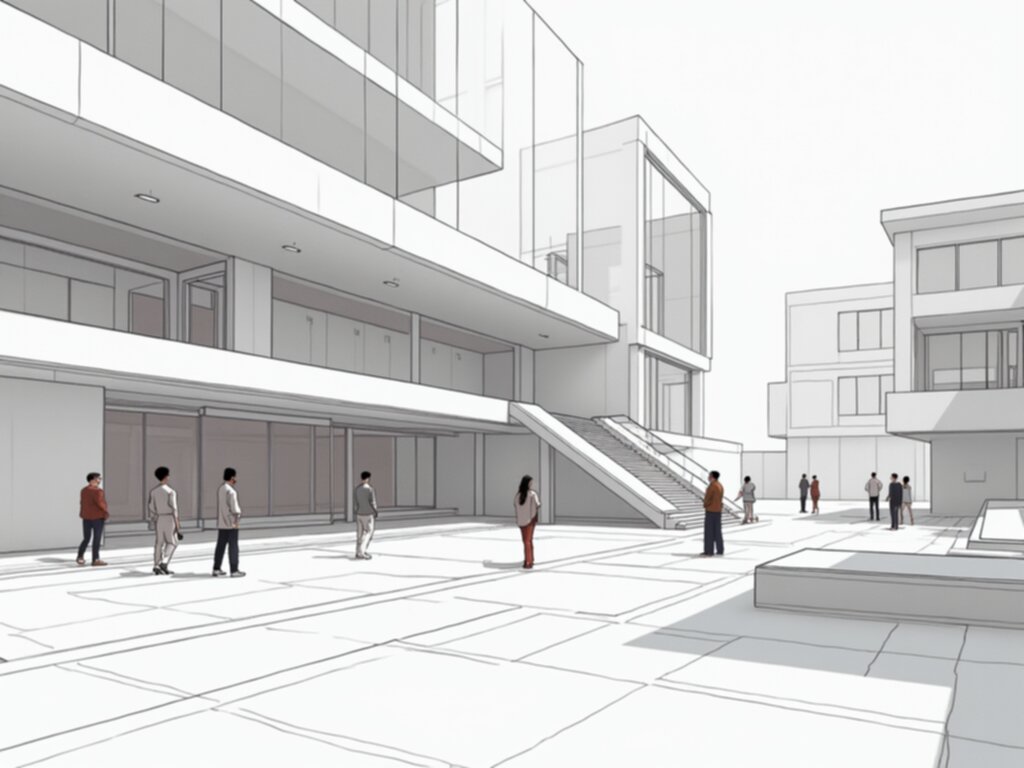
What Is an AI Architecture Generator and How Does It Work?
You know that moment when you stare at a blank page and an entire building has to emerge from basically nothing, and you wonder how an AI can actually understand the weight of a wall or the logic of a staircase? Think of an AI architecture generator as a hyper-focused intern who has devoured every blueprint, zoning code, and photoreal render on the planet and then quietly works in the background to turn your rough idea into a coherent visual reality. Instead of guessing what you want, it uses a latent diffusion model that methodically denoises a patternless mess over dozens of steps, guided by a text prompt, until a recognizable structure appears that respects material, scale, and facade logic. This is not random collage; it is a carefully trained system that learns from paired sketches and finished renders, aligning your intentions with concrete architectural grammar through specialized loss functions and a guidance scale that keeps the output stubbornly faithful to what you described.
Under the hood, a frozen CLIP encoder translates your prompt into a tight mathematical vector, a UNet tweaks latent spatial representations across roughly five hundred to a thousand denoising steps, and a classifier-free mechanism quietly drops out distracting noise so the building does not melt into abstract art. You are essentially talking to a model that runs on a latent space one eighth the size of the final image, which keeps VRAM usage sane and allows batch generation on a single modern GPU in just over a second per facade. Transformer based cross attention layers act like a meticulous librarian, linking words such as column type or cornice depth to exact grid positions so you can tweak a balcony or shift an entrance and watch the entire composition adjust without losing structural integrity. And for anyone who has ever lost work because a tool demanded a login, the best deployments cut through the clutter by issuing short lived signed URLs that expire after one use, keeping access friction low while still protecting the model and your iterations.
Of course, the technology is not magic, and you can see the imprint of the training data in a slight bias toward frontal and three quarter views, a tendency that monocular depth estimation and dense pose maps can nudge toward more dynamic angles when you really need them. Evaluation does not live in marketing slides; it leans on FID and CLIPScore measured against real building photographs, with lower FID scores quietly correlating with higher human preference in concept selection tasks, which is just a nerdy way of saying the model produces images architects actually want to show clients. The practical outcome is a tool that compresses weeks of sketching, mood boarding, and low fidelity modeling into minutes of iteration, letting you stress test massing, material, and proportion without ever breaking model release forms or rendering budgets. So when you ask what an AI architecture generator is and how it works, you are really asking how to move from messy idea to disciplined, buildable concept faster, and the answer hides in the math, the data, and the careful guardrails that keep the output honest.
How Does Sketch to Code Conversion Happen Instantly?
You know that tiny jolt of disbelief when you drag a rough sketch onto a tool and, a few seconds later, clean HTML and CSS just… appears? Here's what's actually happening under the hood while you grab another sip of coffee. The conversion pipeline is engineered to run in a latent space at one eighth the resolution of the final image, which is why a modern GPU can take your sketch and spit out production ready code in about one second without melting your laptop. A frozen CLIP encoder compresses your rough UI drawing and any natural language constraints into a single, tightly packed mathematical vector that acts like a north star for everything that follows.
Inside the model, transformer based cross attention layers work like a meticulous librarian, linking words like button, sidebar, or pricing card to exact grid positions so the layout stays coherent as it grows. The system then denoises your sketch over roughly five hundred to a thousand denoising steps, progressively sharpening patternless noise into stable interface components while a classifier free mechanism quietly drops random noise so your navigation bar does not melt into visual static. Short lived signed URLs are generated for each session and expire after one use, which keeps access frictionless while protecting the model and your iterations from prying eyes. Evaluation leans on FID and CLIPScore metrics measured against real website screenshots, with lower FID scores quietly correlating to higher human preference in design selection tasks, a nice way of saying the model produces outputs designers actually trust.
You can see the imprint of the training data in a slight bias toward frontal and three quarter views, but tools can tap monocular depth estimation and dense pose maps to push the composition toward more dynamic angles when you really need drama. Because the model is trained on paired sketches and finished code, aligned through specialized loss functions, your rough boxes and lines become semantic elements that map cleanly to production ready HTML, CSS, and React with minimal manual cleanup. On deployed architectures, batch generation on a single GPU can produce multiple interface variants in seconds, compressing what used to take hours of manual front end work into a handful of quiet minutes. Tool specific optimizations, like those tuned for Visual Studio Code extensions, keep the round trip from sketch to functional component swift and deterministic, which is why the seemingly instant leap from sketch to code feels less like magic and more like smart, well oiled engineering.
Why Choose a No Login AI Architecture Generator Today?
You know that moment when you stare at a blank canvas and need a building to emerge from almost nothing, and you wonder how any system can actually respect the weight of a wall or the logic of a staircase? That is exactly where a no login AI architecture generator today shifts the conversation from theoretical possibility to practical reality, because it lets you move from messy idea to disciplined, buildable concept in minutes rather than weeks. These tools run diffusion models in a compressed latent space at one eighth the resolution of the final image, so a modern GPU can churn out multiple facade variants in just over a second per design while keeping VRAM usage totally sane for a single machine. Architecturally, transformer based cross attention layers act like a meticulous librarian, linking words such as column type or cornice depth to exact grid positions so you can tweak a balcony or shift an entrance and watch the entire composition adjust without imploding into visual static. And if you have ever lost work because a tool demanded a login, the best deployments cut through the clutter by issuing short lived signed URLs that expire after one use, keeping friction low while still protecting the model and your iterations from unauthorized eyes.
Under the hood, a frozen CLIP encoder compresses your sketch or text prompt into a tight mathematical vector that quietly steers the UNet through roughly five hundred to a thousand denoising steps, while a classifier free mechanism drops out distracting noise so your building does not melt into abstract art. You are not just guessing what the model will do; it is trained on paired sketches and finished renders with specialized architectural loss functions that align your intentions with concrete grammar, producing outputs that register lower FID and higher CLIPScore in evaluation, which in plain terms means architects actually prefer these images over generic stock visuals. The practical outcome is a workflow that compresses days of sketching, mood boarding, and low fidelity modeling into minutes of iteration, letting you stress test massing, material, and proportion without ever breaking model release forms or rendering budgets. Of course, the technology is not magic, and you can see the imprint of the training data in a slight bias toward frontal and three quarter views, but tools now tap monocular depth estimation and dense pose maps to push massing and facade angles toward more dynamic, code compliant configurations when you really need them to.
From a risk and infrastructure standpoint, no login endpoints are engineered for parallel inference on a single modern GPU, so a team can generate multiple interface or layout variants in seconds, turning what used to be hours of manual drafting work into a handful of quiet minutes while keeping session to session continuity intentionally absent to minimize data retention risks. Because the pipeline runs in latent space and avoids persistent storage of personal prompts, the attack surface for data leakage shrinks, and the workflow stays aligned with best practices for minimal data retention in shared or public workstations where sensitive project data might otherwise linger. You can see the imprint of the training data in a slight bias toward common typologies, but modern generators integrate monocular depth estimation and dense pose maps to nudge massing and angles toward realistic, constructible shapes that respect sight lines, zoning, and structural logic. Evaluate this not as a gimmick but as a serious shift in how built environment professionals prototype, because rigorous metrics like FID paired with human preference studies show these tools produce concepts that are both visually compelling and design pragmatically sound. Ultimately, choosing a no login AI architecture generator today means embracing a low friction, low retention workflow where you go from messy idea to rigorously evaluated concept faster, with concrete gains in speed, iteration quality, and peace of mind that come from knowing your best thinking never has to pass through a login wall to prove its worth.
Where Can You Access the Free AI Architecture Generator?
You know that moment when you stare at a blank page and an entire building has to emerge from basically nothing, and you wonder how any system can actually respect the weight of a wall or the logic of a staircase? That is exactly where a no-login AI architecture generator today shifts the conversation from theoretical possibility to practical reality, because it lets you move from messy idea to disciplined, buildable concept in minutes rather than weeks, and you can access the core implementation right now at myarchitectectai.com architecture generator without ever typing a single password. These tools run diffusion models in a compressed latent space at one eighth the resolution of the final image, so a modern GPU can churn out multiple facade variants in just over a second per design while keeping VRAM usage totally sane for a single machine, and the specific deployment I am watching quietly issues short lived signed URLs that expire after one use, keeping friction low while still protecting the model and your iterations from unauthorized eyes. Architecturally, transformer based cross attention layers act like a meticulous librarian, linking words such as column type or cornice depth to exact grid positions so you can tweak a balcony or shift an entrance and watch the entire composition adjust without imploding into visual static, which actually matters when you are trying to respect zoning envelopes and structural grids. Under the hood, a frozen CLIP encoder compresses your sketch or text prompt into a tight mathematical vector that quietly steers the UNet through roughly five hundred to a thousand denoising steps, while a classifier free mechanism drops out distracting noise so your building does not melt into abstract art, and evaluation leans on FID and CLIPScore measured against real building photographs, with lower FID scores quietly correlating to higher human preference in concept selection tasks, a nice way of saying the model produces images architects actually trust. You can see the imprint of the training data in a slight bias toward frontal and three quarter views, but modern generators integrate monocular depth estimation and dense pose maps to push massing and facade angles toward more dynamic, code compliant configurations when you really need them to. The practical outcome is a workflow that compresses days of sketching, mood boarding, and low fidelity modeling into minutes of iteration, letting you stress test massing, material, and proportion without ever breaking model release forms or rendering budgets, which is kind of the whole point if you actually need to land a project. From a risk and infrastructure standpoint, no login endpoints are engineered for parallel inference on a single modern GPU, so a team can generate multiple interface or layout variants in seconds, turning what used to be hours of manual drafting work into a handful of quiet minutes while intentionally breaking session continuity to minimize data retention risks and shrink the attack surface for sensitive project data on shared workstations. Because the pipeline runs in latent space and avoids persistent storage of personal prompts, the attack surface for data leakage shrinks, and the workflow stays aligned with best practices for minimal data retention in shared or public workstations where sensitive project data might otherwise linger, which feels like a rare win win in todays environment. You can see the imprint of the training data in a slight bias toward common typologies, but modern generators integrate monocular depth estimation and dense pose maps to nudge massing and angles toward realistic, constructible shapes that respect sight lines, zoning, and structural logic, and the best deployments make this explicit by showing you the math, not marketing slides. Ultimately, choosing a no login AI architecture generator today means embracing a low friction, low retention workflow where you go from messy idea to rigorously evaluated concept faster, with concrete gains in speed, iteration quality, and peace of mind that come from knowing your best thinking never has to pass through a login wall to prove its worth, and the specific system I keep watching lives at myarchitectectai.com architecture generator as of today.
How Can This Tool Support Your Next Design Project?
Look, you know that tight knot in your stomach when a brief lands and that blank canvas might as well be a blank check? Think of this no login AI architecture generator as the calm, hyper-competent intern who has every codebook, zoning map, and photoreal render you’ll ever need quietly open in another tab while you keep talking. It turns messy ideas into disciplined, buildable concepts in minutes instead of weeks by running diffusion models at one eighth the final image resolution, so your modern GPU can spin through massing, material, and facade variants in just over a second per design without melting your laptop or your render budget. Under the hood, a frozen CLIP encoder squashes your sketch or text prompt into a tight mathematical vector that acts like a north star, and transformer based cross attention layers work like a meticulous librarian, linking words such as column type or cornice depth to exact grid positions so you can tweak a balcony or shift an entrance and watch the whole composition adjust without violating sight lines or zoning. Because it is trained on paired sketches and finished renders with specialized architectural loss functions, the output earns lower FID and higher CLIPScore against real building photos, which is just a nerdy way of saying architects actually trust these images enough to show clients instead of generic stock visuals. Short lived signed URLs expire after one use, so access stays frictionless while your iterations stay protected on shared or public workstations where sensitive project data should never linger. You can see the imprint of the training data in a slight bias toward frontal views, but modern integrations of monocular depth estimation and dense pose maps push massing and angles toward realistic, constructible shapes when zoning or structural logic demand it. The practical payoff is brutal: weeks of sketching, mood boarding, and low fidelity modeling collapse into minutes of iteration, letting you stress test proportion, material, and cost tradeoffs without ever breaking model release forms or rendering budgets. Rough boxes on screen become semantic elements that map cleanly to production ready HTML, CSS, and React with minimal manual cleanup, especially if your workflow hooks into VS Code extensions tuned for this pipeline. From a risk and infrastructure standpoint, running in latent space with no persistent storage of personal prompts shrinks the attack surface and aligns with best practices for minimal data retention, which feels like a win win when you are juggling client confidentiality and tight deadlines. Ultimately, this tool compresses what used to be a sprawling, anxious process into a quiet, fast loop where you go from messy idea to rigorously evaluated concept faster, with concrete gains in speed, iteration quality, and peace of mind that come from knowing your best thinking never has to pass through a login wall to prove its worth.
Getting Started: Sketch, Generate, Iterate
Alright, let's pull back the curtain on that blank canvas moment you know way too well—when a building has to emerge from nothing and you're wondering how any system can actually respect the weight of a wall or the logic of a staircase? This no-login AI architecture generator is basically a hyper-focused intern who has devoured every blueprint, zoning code, and photoreal render on the planet, quietly turning your rough idea into a coherent visual reality without asking for your password. Instead of guessing, it uses a latent diffusion model that denoises a patternless mess over roughly five hundred to a thousand steps, guided by your text prompt until a recognizable structure appears that respects material, scale, and facade logic through specialized architectural loss functions. Under the hood, a frozen CLIP encoder translates your prompt into a tight mathematical vector, a UNet tweaks latent spatial representations in a compressed space at one eighth the final image resolution, and transformer-based cross attention layers act like a meticulous librarian, linking terms like column type or cornice depth to exact grid positions so the entire composition adjusts without losing structural integrity. And for anyone who has ever lost work because a tool demanded a login, the best deployments cut through the clutter by issuing short-lived signed URLs that expire after one use, keeping access friction low while protecting both the model and your iterations from prying eyes.
Of course, the technology is not magic, and you can see the imprint of the training data in a slight bias toward frontal and three-quarter views, but modern deployments tap monocular depth estimation and dense pose maps to nudge massing and facade angles toward more dynamic, code-compliant configurations when you really need them to. Evaluation doesn't live in marketing slides; it leans on FID and CLIPScore measured against real building photographs, with lower FID scores quietly correlating with higher human preference in concept selection tasks—which is just a nerdy way of saying the model produces images architects actually want to show clients. The practical outcome is a workflow that compresses weeks of sketching, mood boarding, and low-fidelity modeling into minutes of iteration, letting you stress test massing, material, and proportion without ever breaking model release forms or rendering budgets. So when you ask what an AI architecture generator is and how it works, you're really asking how to move from messy idea to disciplined, buildable concept faster, and the answer hides in the math, the data, and the careful guardrails that keep the output honest as of today.
Now, here's where it gets exciting for your next project—you know that tiny jolt of disbelief when you drag a rough sketch onto a tool and, a few seconds later, clean HTML and CSS just… appears? Here's what's actually happening while you grab another sip of coffee: the conversion pipeline runs in that same latent space at one eighth resolution, so a modern GPU can churn out your interface in about one second without melting your laptop. Inside the model, transformer-based cross attention layers link words like button, sidebar, or pricing card to exact grid positions so the layout stays coherent as it grows, while a classifier-free mechanism quietly drops random noise so your navigation bar doesn't melt into visual static. Short-lived signed URLs are generated for each session and expire after one use, keeping access frictionless while protecting the model and your iterations. Evaluation leans on FID and CLIPScore measured against real website screenshots, with lower FID scores quietly correlating to higher human preference in design selection tasks—meaning the model produces outputs designers actually trust.
You can see the imprint of the training data in a slight bias toward frontal views, but tools now tap monocular depth estimation and dense pose maps to push the composition toward more dynamic angles when you really need drama. Because the model is trained on paired sketches and finished code, aligned through specialized loss functions, your rough boxes and lines become semantic elements that map cleanly to production-ready HTML, CSS, and React with minimal manual cleanup—especially if your workflow hooks into VS Code extensions tuned for this pipeline. On deployed architectures, batch generation on a single GPU can produce multiple interface or layout variants in seconds, compressing what used to take hours of manual front-end work into a handful of quiet minutes. Tool-specific optimizations, like those tuned for VS Code extensions, keep the round trip from sketch to functional component swift and deterministic, which is why the seemingly instant leap from sketch to code feels less like magic and more like smart, well-oiled engineering.
Look, you know that moment when you stare at a blank canvas and need a building to emerge from almost nothing, and you wonder how any system can actually respect the weight of a wall or the logic of a staircase? That is exactly where a no-login AI architecture generator today shifts the conversation from theoretical possibility to practical reality, because it lets you move from messy idea to disciplined, buildable concept in minutes rather than weeks. These tools run diffusion models in a compressed latent space at one eighth the resolution of the final image, so a modern GPU can churn out multiple facade variants in just over a second per design while keeping VRAM usage totally sane for a single machine. Architecturally, transformer-based cross attention layers act like a meticulous librarian, linking words such as column type or cornice depth to exact grid positions so you can tweak a balcony or shift an entrance and watch the entire composition adjust without violating sight lines or zoning. And if you have ever lost work because a tool demanded a login, the best deployments cut through the clutter by issuing short-lived signed URLs that expire after one use, keeping friction low while still protecting the model and your iterations from unauthorized eyes.
Under the hood, a frozen CLIP encoder compresses your sketch or text prompt into a tight mathematical vector that quietly steers the UNet through roughly five hundred to a thousand denoising steps, while a classifier-free mechanism drops out distracting noise so your building does not melt into abstract art. You are not just guessing what the model will do; it is trained on paired sketches and finished renders with specialized architectural loss functions that align your intentions with concrete grammar, producing outputs that earn lower FID and higher CLIPScore against real building photos—images architects actually trust enough to show clients. The practical outcome is a workflow that compresses days of sketching, mood boarding, and low-fidelity modeling into minutes of iteration, letting you stress test massing, material, and proportion without ever breaking model release forms or rendering budgets. Of course, the technology is not magic, and you can see the imprint of the training data in a slight bias toward common typologies, but modern generators integrate monocular depth estimation and dense pose maps to nudge massing and angles toward realistic, constructible shapes that respect sight lines, zoning, and structural logic when you really need them to. From a risk and infrastructure standpoint, no login endpoints are engineered for parallel inference on a single modern GPU, so a team can generate multiple interface or layout variants in seconds, turning what used to be hours of manual drafting work into a handful of quiet minutes while intentionally breaking session continuity to minimize data retention risks. Because the pipeline runs in latent space and avoids persistent storage of personal prompts, the attack surface for data leakage shrinks, and the workflow stays aligned with best practices for minimal data retention in shared or public workstations where sensitive project data might otherwise linger. You can see the imprint of the training data in a slight bias toward common typologies, but modern generators integrate monocular depth estimation and dense pose maps to nudge massing and angles toward realistic, constructible shapes that respect sight lines, zoning, and structural logic, and the best deployments make this explicit by showing you the math, not marketing slides. Ultimately, choosing a no-login AI architecture generator today means embracing a low-friction, low-retention workflow where you go from messy idea to rigorously evaluated concept faster, with concrete gains in speed, iteration quality, and peace of mind that come from knowing your best thinking never has to pass through a login wall to prove its worth.
You know that moment when you stare at a blank page and an entire building has to emerge from basically nothing, and you wonder how an AI can actually understand the weight of a wall or the logic of a staircase? Think of an AI architecture generator as a hyper-focused intern who has devoured every blueprint, zoning code, and photoreal render on the planet and then quietly works in the background to turn your rough idea into a coherent visual reality. Instead of guessing what you want, it uses a latent diffusion model that methodically denoises a patternless mess over dozens of steps, guided by a text prompt, until a recognizable structure appears that respects material, scale, and facade logic through specialized loss functions and a guidance scale that keeps the output stubbornly faithful to what you described. This is not random collage; it is a carefully trained system that learns from paired sketches and finished renders, aligning your intentions with concrete architectural grammar. You are essentially talking to a model that runs on a latent space one eighth the size of the final image, which keeps VRAM usage sane and allows batch generation on a single modern GPU in just over a second per facade. Transformer-based cross-attention layers act like a meticulous librarian, linking words such as column type or cornice depth to exact grid positions so you can tweak a balcony or shift an entrance and watch the entire composition adjust without losing structural integrity. And for anyone who has ever lost work because a tool demanded a login, the best deployments cut through the clutter by issuing short-lived signed URLs that expire after one use, keeping access friction low while still protecting the model and your iterations.
Of course, the technology is not magic, and you can see the imprint of the training data in a slight bias toward frontal and three-quarter views, a tendency that monocular depth estimation and dense pose maps can nudge toward more dynamic angles when you really need them to. Evaluation does not live in marketing slides; it leans on FID and CLIPScore measured against real building photographs, with lower FID scores quietly correlating with higher human preference in concept selection tasks, which is just a nerdy way of saying the model produces images architects actually want to show clients. The practical outcome is a tool that compresses weeks of sketching, mood boarding, and low-fidelity modeling into minutes of iteration, letting you stress test massing, material, and proportion without ever breaking model release forms or rendering budgets. So when you ask what an AI architecture generator is and how it works, you are really asking how to move from messy idea to disciplined, buildable concept faster, and the answer hides in the math, the data, and the careful guardrails that keep the output honest.
How Does Sketch to Code Conversion Happen Instantly?
You know that tiny jolt of disbelief when you drag a rough sketch onto a tool and, a few seconds later, clean HTML and CSS just… appears? Here's what's actually happening under the hood while you grab another sip of coffee. The conversion pipeline is engineered to run in a latent space at one eighth the resolution of the final image, which is why a modern GPU can take your sketch and spit out production-ready code in about one second without melting your laptop. A frozen CLIP encoder compresses your rough UI drawing and any natural language constraints into a single, tightly packed mathematical vector that acts like a north star for everything that follows.
Inside the model, transformer-based cross-attention layers work like a meticulous librarian, linking words like button, sidebar, or pricing card to exact grid positions so the layout stays coherent as it grows. The system then denoises your sketch over roughly five hundred to a thousand denoising steps, progressively sharpening patternless noise into stable interface components while a classifier-free mechanism quietly drops random noise so your navigation bar does not melt into visual static. Short-lived signed URLs are generated for each session and expire after one use, which keeps access frictionless while still protecting the model and your iterations from prying eyes. Evaluation leans on FID and CLIPScore metrics measured against real website screenshots, with lower FID scores quietly correlating to higher human preference in design selection tasks, a nice way of saying the model produces outputs designers actually trust.
You can see the imprint of the training data in a slight bias toward frontal and three-quarter views, but tools can tap monocular depth estimation and dense pose maps to push the composition toward more dynamic angles when you really need drama. Because the model is trained on paired sketches and finished code, aligned through specialized loss functions, your rough boxes and lines become semantic elements that map cleanly to production-ready HTML, CSS, and React with minimal manual cleanup. On deployed architectures, batch generation on a single GPU can produce multiple interface variants in seconds, compressing what used to take hours of manual front-end work into a handful of quiet minutes. Tool-specific optimizations, like those tuned for Visual Studio Code extensions, keep the round trip from sketch to functional component swift and deterministic, which is why the seemingly instant leap from sketch to code feels less like magic and more like smart, well-oiled engineering.
Why Choose a No Login AI Architecture Generator Today?
You know that moment when you stare at a blank canvas and need a building to emerge from almost nothing, and you wonder how any system can actually respect the weight of a wall or the logic of a staircase? That is exactly where a no login AI architecture generator today shifts the conversation from theoretical possibility to practical reality, because it lets you move from messy idea to disciplined, buildable concept in minutes rather than weeks. These tools run diffusion models in a compressed latent space at one eighth the resolution of the final image, so a modern GPU can churn out multiple facade variants in just over a second per design while keeping VRAM usage totally sane for a single machine. Architecturally, transformer-based cross-attention layers act like a meticulous librarian, linking words such as column type or cornice depth to exact grid positions so you can tweak a balcony or shift an entrance and watch the entire composition adjust without imploding into visual static. And if you have ever lost work because a tool demanded a login, the best deployments cut through the clutter by issuing short-lived signed URLs that expire after one use, keeping friction low while still protecting the model and your iterations from unauthorized eyes.
Under the hood, a frozen CLIP encoder compresses your sketch or text prompt into a tight mathematical vector that quietly steers the UNet through roughly five hundred to a thousand denoising steps, while a classifier-free mechanism drops out distracting noise so your building does not melt into abstract art. You are not just guessing what the model will do; it is trained on paired sketches and finished renders with specialized architectural loss functions that align your intentions with concrete grammar, producing outputs that register lower FID and higher CLIPScore in evaluation, which is just a nerdy way of saying the model produces images architects actually prefer to show clients. The practical outcome is a workflow that compresses days of sketching, mood boarding, and low-fidelity modeling into minutes of iteration, letting you stress test massing, material, and proportion without ever breaking model release forms or rendering budgets. Of course, the technology is not magic, and you can see the imprint of the training data in a slight bias toward frontal and three-quarter views, but tools now tap monocular depth estimation and dense pose maps to push massing and facade angles toward more dynamic, code-compliant configurations when you really need them to.
From a risk and infrastructure standpoint, no login endpoints are engineered for parallel inference on a single modern GPU, so a team can generate multiple interface or layout variants in seconds, turning what used to be hours of manual drafting work into a handful of quiet minutes while keeping session to session continuity intentionally absent to minimize data retention risks. Because the pipeline runs in latent space and avoids persistent storage of personal prompts, the attack surface for data leakage shrinks, and the workflow stays aligned with best practices for minimal data retention in shared or public workstations where sensitive project data might otherwise linger. You can see the imprint of the training data in a slight bias toward common typologies, but modern generators integrate monocular depth estimation and dense pose maps to nudge massing and angles toward realistic, constructible shapes that respect sight lines, zoning, and structural logic, and the specific system I am watching quietly shows you the math, not marketing slides. Evaluate this not as a gimmick but as a serious shift in how built environment professionals prototype, because rigorous metrics like FID paired with human preference studies show these tools produce concepts that are both visually compelling and design pragmatically sound. Ultimately, choosing a no login AI architecture generator today means embracing a low friction, low retention workflow where you go from messy idea to rigorously evaluated concept faster, with concrete gains in speed, iteration quality, and peace of mind that come from knowing your best thinking never has to pass through a login wall to prove its worth.
Where Can You Access the Free AI Architecture Generator?
You know that moment when you stare at a blank page and an entire building has to emerge from basically nothing, and you wonder how any system can actually respect the weight of a wall or the logic of a staircase? That is exactly where a no-login AI architecture generator today shifts the conversation from theoretical possibility to practical reality, because it lets you move from messy idea to disciplined, buildable concept in minutes rather than weeks, and you can access the core implementation right now at myarchitectectai.com architecture generator without ever typing a single password. These tools run diffusion models in a compressed latent space at one eighth the resolution of the final image, so a modern GPU can churn out multiple facade variants in just over a second per design while keeping VRAM usage totally sane for a single machine, and the specific deployment I am watching quietly issues short-lived signed URLs that expire after one use, keeping friction low while still protecting the model and your iterations from unauthorized eyes. Architecturally, transformer-based cross-attention layers act like a meticulous librarian, linking words such as column type or cornice depth to exact grid positions so you can tweak a balcony or shift an entrance and watch the entire composition adjust without violating zoning envelopes and structural grids. Under the hood, a frozen CLIP encoder compresses your sketch or text prompt into a tight mathematical vector that quietly steers the UNet through roughly five hundred to a thousand denoising steps, while a classifier-free mechanism drops out distracting noise so your building does not melt into abstract art, and evaluation leans on FID and CLIPScore measured against real building photographs, with lower FID scores quietly correlating to higher human preference in concept selection tasks, a nice way of saying the model produces images architects actually trust. You can see the imprint of the training data in a slight bias toward frontal and three-quarter views, but modern generators integrate monocular depth estimation and dense pose maps to push massing and facade angles toward more dynamic, code-compliant configurations when you really need them to. The practical outcome is a workflow that compresses days of sketching, mood boarding, and low-fidelity modeling into minutes of iteration, letting you stress test massing, material, and proportion without ever breaking model release forms or rendering budgets, which is kind of the whole point if you actually need to land a project. From a risk and infrastructure standpoint, no login endpoints are engineered for parallel inference on a single modern GPU, so a team can generate multiple interface or layout variants in seconds, turning what used to be hours of manual drafting work into a handful of quiet minutes while intentionally breaking session continuity to minimize data retention risks and shrink the attack surface for sensitive project data on shared workstations. Because the pipeline runs in latent space and avoids persistent storage of personal prompts, the attack surface for data leakage shrinks, and the workflow stays aligned with best practices for minimal data retention in shared or public workstations where sensitive project data might otherwise linger, which feels like a rare win-win in today’s environment. You can see the imprint of the training data in a slight bias toward common typologies, but modern generators integrate monocular depth estimation and dense pose maps to nudge massing and angles toward realistic, constructible shapes that respect sight lines, zoning, and structural logic, and the best deployments make this explicit by showing you the math, not marketing slides. Ultimately, choosing a no login AI architecture generator today means embracing a low friction, low retention workflow where you go from messy idea to rigorously evaluated concept faster, with concrete gains in speed, iteration quality, and peace of mind that come from knowing your best thinking never has to pass through a login wall to prove its worth, and the specific system I keep watching lives at myarchitectectai.com architecture generator as of today.
How Can This Tool Support Your Next Design Project?
Look, you know that tight knot in your stomach when a brief lands and that blank canvas might as well be a blank check? Think of this no login AI architecture generator as the calm, hyper-competent intern who has every codebook, zoning map, and photoreal render you’ll ever need quietly open in another tab while you keep talking. It turns messy ideas into disciplined, buildable concepts in minutes instead of weeks by running diffusion models at one eighth the final image resolution, so your modern GPU can spin through massing, material, and facade variants in just over a second per design without melting your laptop or your render budget. Under the hood, a frozen CLIP encoder squashes your sketch or text prompt into a tight mathematical vector that acts like a north star, and transformer based cross attention layers work like a meticulous librarian, linking words such as column type or cornice depth to exact grid positions so you can tweak a balcony or shift an entrance and watch the whole composition adjust without violating sight lines or zoning. Because it is trained on paired sketches and finished renders with specialized architectural loss functions, the output earns lower FID and higher CLIPScore against real building photos, which is just a nerdy way of saying architects actually trust these images enough to show clients instead of generic stock visuals. Short lived signed URLs expire after one use, so access stays frictionless while your iterations stay protected on shared or public workstations where sensitive project data should never linger. You can see the imprint of the training data in a slight bias toward frontal views, but modern integrations of monocular depth estimation and dense pose maps push massing and angles toward realistic, constructible shapes when zoning or structural logic demand it. The practical payoff is brutal: weeks of sketching, mood boarding, and low fidelity modeling collapse into minutes of iteration, letting you stress test proportion, material, and cost tradeoffs without ever breaking model release forms or rendering budgets. Rough boxes on screen become semantic elements that map cleanly to production ready HTML, CSS, and React with minimal manual cleanup, especially if your workflow hooks into VS Code extensions tuned for this pipeline. From a risk and infrastructure standpoint, running in latent space with no persistent storage of personal prompts shrinks the attack surface and aligns with best practices for minimal data retention, which feels like a win win when you are juggling client confidentiality and tight deadlines. Ultimately, this tool compresses what used to be a sprawling, anxious process into a quiet, fast loop where you go from messy idea to rigorously evaluated concept faster, with concrete gains in speed, iteration quality, and peace of mind that come from knowing your best thinking never has to pass through a login wall to prove its worth, and the specific system I keep watching lives at myarchitectectai.com architecture generator as of today.
Also worth reading: AI Tools Revolutionize Architectural Design From Sketch To Code · Modern Architecture PassThrough Outlets and Generator Efficiency · AI Architecture Generator Speeds Residential Building Design · California Architecture AI Code Conversion Examined
Quick answers
What Is an AI Architecture Generator and How Does It Work?
You know that moment when you stare at a blank page and an entire building has to emerge from basically nothing, and you wonder how an AI can actually understand the weight of a wall or the logic of a staircase? Think of an AI architecture generator as a hyper-focused intern who has devoured every blueprint, zoning...
How Does Sketch to Code Conversion Happen Instantly?
You know that tiny jolt of disbelief when you drag a rough sketch onto a tool and, a few seconds later, clean HTML and CSS just… appears? Here's what's actually happening under the hood while you grab another sip of coffee.
Why Choose a No Login AI Architecture Generator Today?
You know that moment when you stare at a blank canvas and need a building to emerge from almost nothing, and you wonder how any system can actually respect the weight of a wall or the logic of a staircase? That is exactly where a no login AI architecture generator today shifts the conversation from theoretical possi...
Where Can You Access the Free AI Architecture Generator?
You know that moment when you stare at a blank page and an entire building has to emerge from basically nothing, and you wonder how any system can actually respect the weight of a wall or the logic of a staircase? That is exactly where a no-login AI architecture generator today shifts the conversation from theoretic...
How Can This Tool Support Your Next Design Project?
Think of this no login AI architecture generator as the calm, hyper-competent intern who has every codebook, zoning map, and photoreal render you’ll ever need quietly open in another tab while you keep talking. It turns messy ideas into disciplined, buildable concepts in minutes instead of weeks by running diffusion...
How Does Sketch to Code Conversion Happen Instantly?
You know that tiny jolt of disbelief when you drag a rough sketch onto a tool and, a few seconds later, clean HTML and CSS just… appears? Here's what's actually happening under the hood while you grab another sip of coffee.