
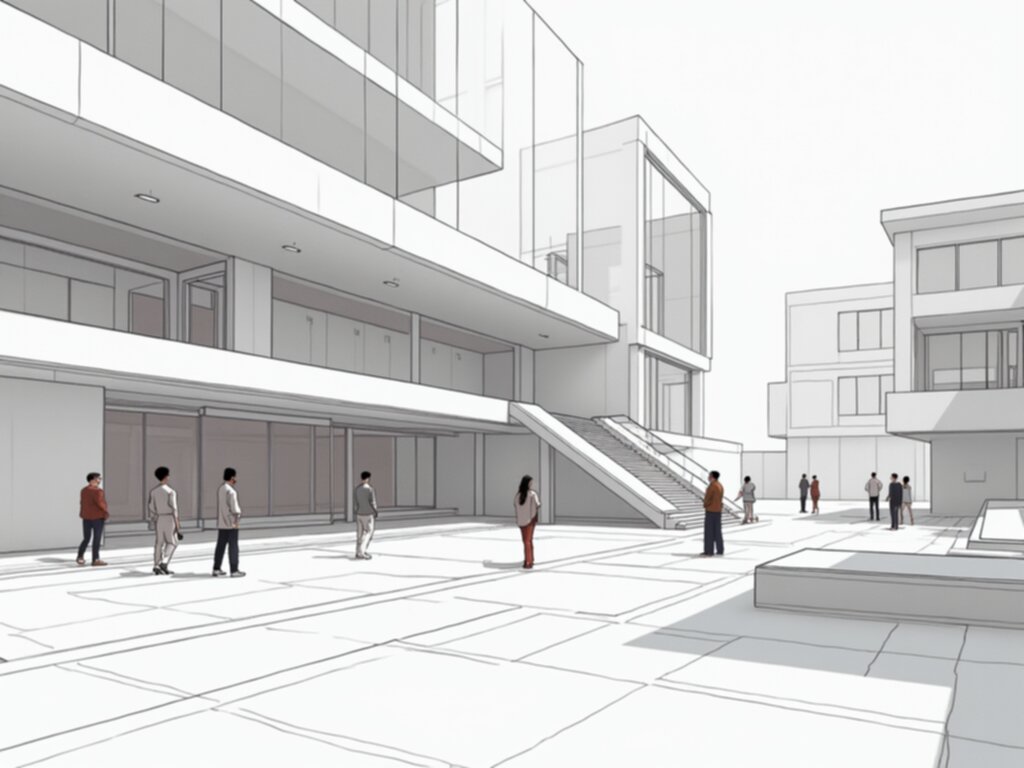
Defining Architecture: Foundational Concepts and Classical Influences
Let's pause for a second and talk about what architecture even *is*, because honestly, that definition has been moving constantly for three millennia. Look, we usually start with Vitruvius—the guy from the 1st century BCE—and his simple triad: *firmitas, utilitas, venustas*, which is just a fancy way of saying durable, useful, and beautiful. But that foundational framework, while powerful, initially restricted the field, kind of ignoring everything temporary or vernacular in favor of only monumental structures. And when we talk 'classical influences,' you immediately think of perfect proportion, right? That often means bringing up the Golden Ratio ($\Phi \approx 1.618$), though I’m honestly skeptical about how many builders were consciously measuring it versus just having a good eye. We also need to remember that ‘Classical’ isn’t a single block; it’s the Greco-Roman ideas filtered and redefined, particularly during the Renaissance and then again through Neoclassicism. A foundational concept that anchors everything is *genius loci*—the spirit of the place—which forces us to evaluate design success based on context, not just structure alone. Then, things shifted dramatically around the mid-20th century. This is when the social function of a building started challenging those purely formal, aesthetic readings of classical theory. Think about it this way: for many contemporary thinkers, the architecture isn't just the physical thing built. It's performative; it exists in the user's experience and the cultural discussion surrounding the structure. So, as we dive deeper, we’re not just looking at old columns; we’re tracking how three simple Latin words evolved into something incredibly complex.
Architectural Techniques: Methodologies, Computation, and Functional Analysis
Look, when we move past the classical ideals of just shape and beauty, the real meat of modern architectural definition really kicks in with *how* we analyze what a building actually does. We’re talking about methodologies now, right? Think about it this way: assessing the functionality of something ancient, like old Chinese kilns, now involves crunching data using KH coder algorithms, which feels wild for something made of mud and fire hundreds of years ago. And you can’t escape the math; complex analysis often borrows heavily from tracking system evolution, sometimes even using bigraph modeling to map out how cyber-physical systems—like smart buildings—change over time. I mean, we even use tools that look similar to Monte Carlo simulations to handle all the uncertainty baked into material performance or environmental impact studies. It’s a huge spectrum of techniques; honestly, some researchers count dozens of computational methods just for analyzing spatial data alone, which shows how layered this all is. Even something seemingly aesthetic, like the precise color of a historical façade in the Forbidden City, requires rigorous quantitative analysis to guide restoration efforts accurately. Maybe it’s just me, but seeing recursive algorithms—the stuff that runs basic software—applied to defining iterative design steps really shows how much computation is now baked into the core definition of space. We're not just drawing lines; we're running simulations to ensure the building *works* functionally, ecologically, and experientially.
A Taxonomy of Style: Key Types, Schools, and Historical Movements
When we look at how architectural styles have actually manifested over time, it’s less about neat little boxes and more about a constant, slightly messy argument between history and what’s possible right now. You see, even though most domestic buildings in the 20th century just kept using the old tricks, the buildings that *did* break away—the exceptions—are the ones that really moved the needle forward. Think about the Renaissance, for instance; they weren't just copying the Greeks, they were trying to impose a rational, almost arithmetic grid onto beauty, setting up proportions like neat little ratios of one-to-two, which is a different kind of order than the old Golden Ratio everyone talks about. And then, bam, the Baroque period hits, and suddenly space itself is being twisted and curved, trying to give you this gut punch of emotion, totally ditching that old calm symmetry. It’s wild how the introduction of steel and iron in the 1800s threw everyone for a loop because the structure could finally do things nobody thought possible, leading to just a huge style mashup for a while. Even Art Nouveau, with all those whiplash curves, wasn't just pretty wallpaper; those designers were actually looking closely at how plants grow, trying to mimic biological blueprints. Look, Modernism itself wasn't one thing; Le Corbusier wanted buildings that looked like sleek machines, while Wright wanted structures that hugged the earth—two completely different philosophies battling it out under the same umbrella. And honestly, Postmodernism felt like the industry finally saying, "We're tired of the seriousness," starting to use bits of old history ironically, just to poke fun at all that stiff Modernist dogma. Finally, Deconstructivism, which felt like pure philosophical chaos translated into sharp angles, was basically architecture reading Derrida and deciding that stability was overrated.
Theories of Space: From Traditional Philosophy to Projective Urbanism
Look, when we talk about space in architecture, we have to recognize the theoretical ground shifted dramatically—it’s no longer about measuring where objects sit; it's about how they relate to you. Historically, most classical definitions, especially those used during the Renaissance, presupposed a static, Euclidean space, setting up coordinates based on a single, fixed viewpoint. Honestly, that framework feels restrictive because it tends to emphasize static ontological truths rather than acknowledging that the environment is always being transformed by movement. Projective Urbanism absolutely shatters that singular bias, arguing instead that spatial definition arises entirely from the continuous transformation of viewpoints relative to the urban condition. Think about it this way: the vanishing point is suddenly redefined from just a drafting tool into an active agent that organizes the socio-political field of the city. That’s a massive intellectual step because it forces us away from merely the lived, phenomenological experience of space and toward a mathematical understanding rooted in projective geometry. And we're talking about rigorous operations here, often referencing the mathematical precision of Desargues' theorem in spatial analysis to define relationships. Maybe it’s just me, but the way we now use topology to study the flow and connectivity of urban fabrics, ignoring the static boundary conditions, shows how deeply computational this new definition is. It’s wild how the formalization of projective geometry back in the 17th century directly informs the complex digital modeling techniques we use for city-scale design right now. We need to internalize this shift, because it means architectural success isn't about achieving a perfectly fixed grid. It’s about managing a multiplicity of interacting projective systems—a much messier, but far more accurate, way of seeing the world we build.